SKU: 21233718525
potted areca palm

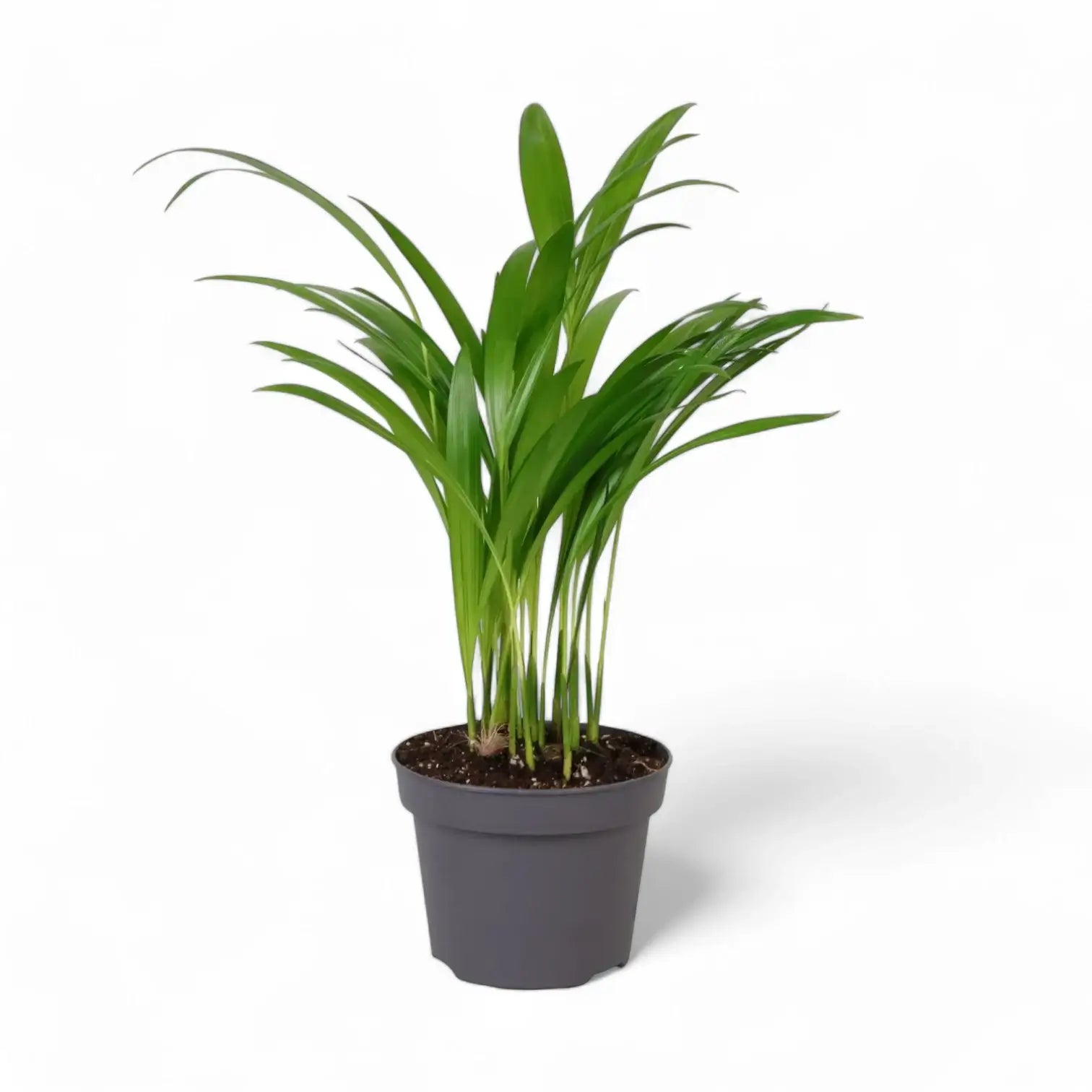
potted areca palm Chrysalidocarpus lutescens

Sale price$24.86 Regular price$27.62
Save 10%

Pay in installments of $6.91 with ShopPay, AfterPay and Klarna

Shipping Estimate
USA
  • USA
  • CAN

Ships within 48 hours · Estimated delivery Aug 17 - Aug 22

Promo Codes Available:

For Your Every Summer RSVP, with Code: SUMMER15

Description

potted areca palm Chrysalidocarpus lutescensChrysalidocarpus lutescens Chrysalidocarpus lutescens, still widely known under the synonym Dypsis lutescens, is a clustering palm with upright cane like stems and long, arching feather leaves. Several stems rise from the base, creating a soft, fountain shaped crown with yellow green petioles and narrow leaflets arranged along each frond. Indoors, this palm develops slowly into a broad, leafy specimen with a layered vertical outline. As the stems

Chrysalidocarpus lutescens

Chrysalidocarpus lutescens, still widely known under the synonym Dypsis lutescens, is a clustering palm with upright cane-like stems and long, arching feather leaves. Several stems rise from the base, creating a soft, fountain-shaped crown with yellow-green petioles and narrow leaflets arranged along each frond.

Indoors, this palm develops slowly into a broad, leafy specimen with a layered vertical outline. As the stems mature, they become more defined, while the fronds keep the crown airy, layered, and finely textured.

Golden cane palm details

  • Golden cane palm forming grouped yellow-green stems
  • Arching pinnate fronds with many narrow green leaflets
  • Yellow-green leaf stalks and midribs give the plant its warm tone
  • Can form a sizeable indoor floor plant over time
  • Rarely flowers indoors; mature outdoor plants may produce yellow flowers and small fruits

Eastern Madagascar origin and clumping growth

Chrysalidocarpus lutescens is native to Madagascar and belongs to the palm family, Arecaceae. In habitat and tropical cultivation it can grow as a shrub-like or tree-like palm, with multiple stems forming a broad clump. Indoors, its final shape depends on light, root space, and steady watering.

Each stem grows from a central crown. Fully brown fronds can be removed at the base, while green fronds should stay in place so the palm retains enough leaf area for new fronds. New fronds emerge from the growing points and gradually open into the palm’s feathered canopy.

Because this palm forms a clump, uneven growth is normal: some canes may sit lower while newer stems fill the centre. Turn the pot occasionally so the crown develops evenly, and keep the leaf bases open enough for inspection because pests often settle where the fronds meet the stems.

Keeping Chrysalidocarpus lutescens evenly leafy

  • Light: Use a bright, indirect position. Gentle morning or late afternoon sun suits acclimated plants, while strong midday sun behind glass can scorch fronds.
  • Watering: Keep the substrate evenly lightly moist during active growth, then let the upper layer dry before watering again. Avoid cold, saturated soil.
  • Substrate: Use an airy, well-drained palm or houseplant mix with mineral drainage material to keep the root zone open.
  • Temperature: Keep the palm warm, ideally above 18 °C, and avoid cold draughts or temperatures below about 15 °C.
  • Humidity: Average to moderate indoor humidity is workable, although very dry heated air can crisp leaflet tips. Use a humidifier where winter air becomes persistently dry.
  • Feeding: Use a low-strength fertiliser in spring and summer. Too much feed can show as yellowing or salt stress on leaflet tips.
  • Repotting: Move up one pot size when roots have filled the container, often after 2–3 years. Avoid oversized pots that keep the mix wet for too long.
  • Pruning: Remove only fully spent fronds. Cutting green fronds reduces the palm’s active leaf area.
  • Leaf cleaning: Wipe dusty leaflets gently or rinse the fronds with lukewarm water so the narrow leaflets can receive light evenly.

Frond, cane and pest checks

  • Brown tips: Often linked to dry air, irregular watering, salt build-up, or old leaf age. Check moisture pattern and flush the substrate if fertiliser salts have built up.
  • Yellowing fronds: Can follow overwatering, poor drainage, low light, nutrient imbalance, or natural ageing of older leaves. Check the root zone before feeding.
  • Mites or scale insects: Fine stippling, webbing, sticky residue, or bumps on stems and leaf bases need early inspection and treatment.
  • Collapsed stems: Soft bases usually point to root or crown stress from persistently wet, cool conditions.

Pet-safe palm status

ASPCA treats the areca palm, Chrysalidocarpus lutescens, as non-toxic to cats and dogs. Sensitive pets may still get mild stomach upset from chewing the fronds.

Accepted name and synonym note

Chrysalidocarpus lutescens H.Wendl. is the accepted botanical name for this Arecaceae species. Dypsis lutescens remains a common synonym in horticulture. The genus name refers to chrysalis-like fruits, while lutescens means turning yellow, matching the yellow tones in the flowers, stems, and leaflet midribs.

Chrysalidocarpus lutescens grows into golden cane clusters with airy fronds and a full upright palm outline.

Shipping Notes
  • Free Standard Shipping on $100+ Orders to the USA.
  • Except Preorder products are shipped in 48 hours.
  • Delivery to the USA:
  1. Standard Shipping : 3-10 business days
  • If time is of the essence, please consider selecting expedited delivery for faster service.
Exchange/Return Notes
  • We offer a 30-day return/exchange service after receiving.
  • Final sale items are not eligible for returns or exchanges.
  • To process your return/exchange, please contact us at [email protected]
  • Please click here for more details>>> Return & Exchange Policy
SKU: 21233718525

Discover Niche Categories That Outsell potted areca palm

Top-Converting Item to Boost Your Average Order

4.5 ★★★★★
Based on 26 reviews
Sort
Highest Rating
Newest First
Oldest First
Product Reviews
J
Verified Purchase
John Beeson
West Palm Beach, US
★★★★★ 5
Profoundly biblical and wise
Format: Paperback
David Powlison’s Good and Angry is a powerful book. In the book Powlison dives deep into what anger is and then gets very practical about how to biblically deal with your own anger issues (issues, he assures us, we all have). From the outset, Powlison makes it clear that anger, while dangerous, can be handled to produce good. “At its core anger is very simple,” Powlison says, “It expresses ‘I’m against that’” (39). Powlison says that each of us handles anger differently. Some of us freeze over, some of us quietly brood, some of us simmer, some of us explode. Powlison encourages us not to look at the way others mismanage worse than us, but rather, how do we mismanage anger? Each type has their own blind spots. Powlison then dives into anger itself. Anger is about our displeasure toward something, so what are we displeased with? And why? How are we justified? Unjustified in our anger? And what do I want to happen? Anger is physiological. As embodied beings, anger manifests itself in us physiologically. How is it impacting me when I’m angry? Powlison then dives into mercy, what he calls a constructive displeasure, or constructive anger. When the constructive displeasure of mercy is functioning as it ought, it has four characteristics: patience (a wonderful biblical synonym of patience is “forbearance”), forgiveness (which is “mercifully unfair” (80)), charity (a spirit of magnanimity), and constructive conflict (“Mercy is not a free pass. It is an invitation to turn and repent” (94). All of these fundamentally point to the work of God and his righteous response of anger to our rebellion. “The constructive displeasure of mercy means the redemption of the world” (102). Powlison walks through how God’s anger works: through his righteous and holy response to our sin, to him taking his wrath upon his son on the cross. He concludes, “God’s wrath is your hope. God’s wrath is my hope. We don’t often hear that, but it appears everywhere in the Bible. Wrath is our hope because love masters anger” (121). The final portion of the book steps back and helps us move through analyzing our own anger. Powlison uses James 4:1-12 to help us analyze our own anger issues. At the heart of this analysis is James’s own analysis of his hearer, that they are fighting and quarrelling because of their “desires that battle within” them. In other words, if we have an anger problem (which we all do), we have a malformed desire problem. In other words, we have a heart problem. Significant in digging into this question is the ability to analyze my own motives. The issue isn’t what has happened with me, but is my heart and my heart’s motives and desires in the midst of any given situation. Key questions to ask myself when in a moment of anger are: “what do I want?” “what do I fear?” and “what do I most love?” (154-55). Powlison concludes with a strong word of hope. God is in the process of changing us and reshaping our heart. Our problem, Powlison says, is that we tend to talk to the wrong person in the midst of our anger – ourselves. But when we turn and talk to our Good Shepherd, we will experience hope and change. I’m so grateful for Powlison's Good and Angry. It is a profoundly biblical and wise book with both subtle and profound insights. I know I have been impacted by the book personally and will both turn to it in the future for personal use and as a resource for others who struggle with anger.
WAS THIS REVIEW HELPFUL?YesReportShare
Reviewed in the United States on April 21, 2017
A
Verified Purchase
AMZRKB
Charlottesville, US
★★★★★ 5
But he is also convinced that your anger does not have to be a problem and this book is intended to help redirect so that we can
Format: Paperback
David Powlison thinks you have an anger problem, and a serious one at that. It is not because he knows you personally, but because he is one who has long studied the fallen heart. But he is also convinced that your anger does not have to be a problem and this book is intended to help redirect so that we can be both good and angry. Anger, as Powlison who is the executive directory of CCEF, defines it, is a sense of opposition to something that is both important and wrong. That means it is a moral response. As those who are created in the image of God we all have come wired for the capacity to express anger. But, as Powlison carefully shows, we have a problem. Our anger is misdirected and misguided because of sin. Not only in the little daily frustrations and irritations, but also in extremely destructive ways. The goal, according to Powlison, is not to eliminate anger, but to have it remade into the image of God by the grace of the gospel. Far from being a therapeutic self-help book, his concern is that we come to understand how anger can coexist with forgiveness, patience, charity, and constructive displeasure. This book should prove to be an excellent resource. However, if you pick it up with the intention to help someone else—your husband, wife, child, friend, or congregant—be prepared to confront the reality of your own anger first. Powlison has a wonderful way of acutely diagnosing anger as a personal problem for all, even those who do not consider themselves angry. A couple of highlights would be his detailed examination of God's wrath showing readers why it is actually because of God's wrath that we have hope. His chapters dealing with every day anger, long-held bitterness, and anger against God also flow from a counselor's heart as he addresses difficult and awful painful truths.
WAS THIS REVIEW HELPFUL?YesReportShare
Reviewed in the United States on September 23, 2016
F
Verified Purchase
FantasyGirl
Phoenix, US
★★★★★ 4
Good Christian Perspective on Anger
Format: Paperback
I read this book over the course of three months; it was not hard to get through but other books had to be read first because of library due dates and without intent, it kept getting pushed lower on my priority read list. I finally got back to it earlier this week and finished up the remaining chapters. After reading it, I have a better understanding of anger through a Christian perspective. Author David Powlinson is a counselor so he brings with him expertise in working with people who have suffered bad things. Unlike some counselors who give guidance without the Scripture, Powlinson incorporates God and His love in each chapter since God is the ultimate source of freeing us from the burden of anger and the other emotions that accompany anger. The book is broken down into four sections: Our Experience, What is Anger?, How to Change, and Tackling the Hard Cases. Everyone is plagued by anger of different intensities and gets angry for different reasons and everyone deals with it in different ways, yet we are all the same in that we need to face our anger and seek God’s guidance so we may handle our anger in a constructive and positive way that glorifies Him. That is why I recommend this book to everyone, especially those who may be going through a hardship in life that makes them angry. I did not agree with everything Powlinson said or may not have understood where he was coming from on some things, but I still think he did a great job writing a book on a massive and complicated subject.
WAS THIS REVIEW HELPFUL?YesReportShare
Reviewed in the United States on January 6, 2018
A
Verified Purchase
A.J. Passantino
Omaha, US
★★★★★ 5
Brilliant and detailed.
Format: Kindle
I can’t say a single thing I felt missing from this book and can go on and on about what was included that I didn’t expect and found greatly helpful.
WAS THIS REVIEW HELPFUL?YesReportShare
Reviewed in the United States on October 22, 2025
P
Verified Purchase
Paul H. Pompa
West Palm Beach, US
★★★★★ 5
❤️❤️❤️
Format: Kindle
This is an almost surgical approach to anger. I’ve never read anything like it. Part of me says of course there’s a counseling approach to anger. But another part of me says I had no idea that anger could be dissected with such precision. There is a ton of great theology. There is also clear practical application. In my estimation, it is a very balanced presentation of anger. It was a slightly difficult read, but only because I wanted to process it well, and consider how I might apply it to my own life.
WAS THIS REVIEW HELPFUL?YesReportShare
Reviewed in the United States on March 8, 2024

recommand products